Showing posts with label Market. Show all posts

Thursday, May 26, 2016

The New Testaccio Market


It's been at least 4 years since the residents of Testaccio in Rome have had their daily market moved to an indoor venue 6 blocks from its former location on Via Luca della Robbia. For many years the old outdoor market suffered during inclement weather for lack of customers and discomfort for the vendors. The new building changes all that and even offers underground parking. Although this market has long hosted residents from all over the city, it is now easier for non locals to shop there. I'm pleased to be part of that group.


The primary purpose of the mercato is to supply fresh poultry, fish, pork, beef, cold cuts and produce to the neighborhood. The poultry can be quite varied as seen in this photo.


Now that the stalls have a roof over them, vendors are upgrading methods of keeping their products in better condition. For example, the fish monger can keep flies off his seafood by covering it with parchment paper that will not blow away in the wind. 


Most of the meats are now in permanent, refrigerated cases that keep them at optimum temperatures. This provides not only for preserving  freshness, but eliminates any worry one might have about contamination from insects and bacteria. That's a big improvement.


When renting apartments in Italy, I have occasionally cooked more than breakfast. This rib roast caught my eye, but the fantasy of a full dinner diminished as I imagined trying to clean an oven. If I was convinced it was Chianina beef, the fantasy may live on, but I'm not certain that it's sold outside of Tuscany.


Rome, like most of Italy, is pork centric, so you see it in many forms while you stroll through the mercato.
In this photo, there appear to be a combination of pancetta, the Italian, non smoked bacon; ham, and guanciale. The round, fatty piece is guanciale, the cured pig jowl that is  traditionally used in a traditional  Carbonara recipe.


Fruits and vegetables abound in the market and are interspersed with many of the other items sold there. It would be easier to shop if all products of a like kind were in the same area.


As things stand, there is a loose affiliation between food groups along with prepared foods. But you are bound to find exceptions with general merchandise in the mix.

Prepared foods are putting in a strong showing too. Today I saw a white Veal Ragu that looked every bit as good as those I've seen in restaurants. It was so entrancing, I failed to take a photo. 


Prepared, although not precooked, the polpette (meatballs) in these photos are at the very least a convenience food in Italy. Those below are actually cooked and ready to heat and serve.
 

Plenty of vendors are prepared to part with  baked goods including pastries, biscotti, rolls, breads and the ever favorite, here in Rome, Pizza Bianca, the Roman answer to focaccia. Even better, are the pizze with various toppings.


I highly recommend that anyone who has never tried a squash blossom nor a porcini mushroom "bianca" style pizza (without tomato sauce) give it a try here. They're two of my favorites, even though I still like the zucchini, as well as the potato and rosemary versions.


The typical pizza bianca, as well as the other pizze, may appear to have a cracker like exterior, but there's a factor of chewiness inside that raises them to another level. Pizza Bianca with its drizzled olive oil surface is delicious on its own, but even better when paired with any of the cold cuts and cheese sold at the mercato.


Gourmet shops selling these types of panini abound in Testaccio. So buy your own ingredients at the market or let someone else make one for you, but don't miss trying some.


Mercado Testaccio is also home to many shops selling clothing, shoes and handbags. Some are vintage, others sell only accessories, jewelry or leather goods. All live happily under one roof. 


On my most recent trip, I discovered Bee Joux, a shop selling women's accessories, including Italian leather purses and French jewelry. Even though I try to buy locally made products, the jewelry was too tempting, so I succumbed and bought a set, deluding myself into thinking it was still okay, since I had been to France on the same trip.


The tables with clothing piled high on top, with a bargain basement appeal, attract many customers, no doubt hoping to find an under priced treasure, but I couldn't bring myself to memorialize them with a photo.


If American vintners are willing to sell wine in boxes, how can I criticize Italian wine served up in plastic bottles? Whether bringing their own bottles, or purchasing a plastic bottle at the wine shop, Italians can satisfy their love of wine locally by paying for it by the liter. Casks of wine from all over Italy can be found at wine shops in Rome.

Thursday, October 29, 2015

Finding Bad Food in Italy

Since the very day I started traveling there, I have said that you would have great difficulty in finding a bad meal in Italy. Italians are exceptionally proud of their culture and express that through their food, by keeping their recipes regional and passing them down from one generation to the next. You, as a traveler, only need to seek out restaurants that advertise regional specialties to find a good meal.


That was then, but this is now, after a visit to Bolzano. You can easily find a bad meal in Italy if you try ordering a pasta dish or a pizza in this town. Travelers expect to eat pasta in Italy, but in Bolzano, you are better off ordering Austrian specialties. Bolzano is too Austrian for the Italians and too Italian for the Austrians. You hear both languages in the streets, but there seems to be no blending of the cultures, unless you choose fusion type food, which I suspect, satisfies no one.

I was so upset after our 2nd meal, that I wondered out loud why Italy didn't just give it back to Austria. I later mentioned this to a young waiter we met from Trento, and his response was matter of fact. He said that Austria didn't want it, thinking it too Italianized. He went on to say that after World War II, when the borders changed, Italy transported many Southern Italians to Bolzano in an attempt to integrate more of their culture into the area.


If Southern Italians migrated there, what happened to their ability to make pasta? They invented tomato sauce and Pasta Puttanesca. How could they be abandoned?  The tomato based lasagne I ordered would have been better if it were the frozen product of Stoffer; ironic since the company name sounds Germanic. Our pizza was soggy; yes, we stooped to that for dinner, because we craved an Italian taste. This is something one does not expect to find in Italy, the country that invented the pizza.


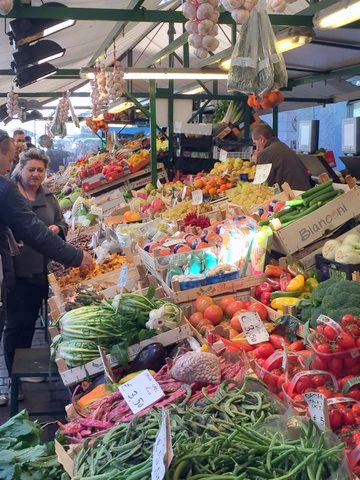
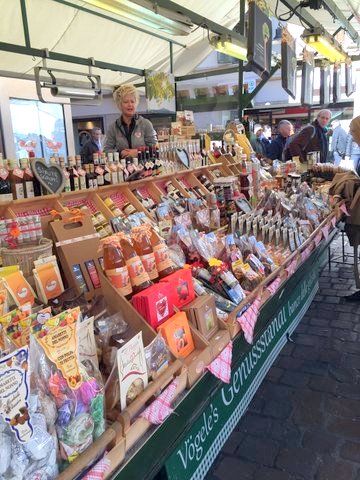
Bolzano has a lively open air market in town and as we wandered through it, we saw all the ingredients one would need for making traditional Italian recipes; tomatoes, herbs, meats and classic Italian cheese. There seemed no good excuse for the lack of classic Italian dishes.


If the truth be known, we decided to add Bolzano and Trento to our itinerary, just to get away from schnitzels for awhile. As much as we liked Bolzano as a small city, we looked forward to finding good Italian food in Trento, and we did.


Bolzano is worth a trip for architecture, shopping, strolling and just about anything else except food. The one exception was the pastry, which looked spectacular, as you can see by the following photo. Those in front are made with chestnut puree and rich dark chocolate.


Having lost over 1200 digital photos during this trip, I regret to be unable to inform you of the restaurants to avoid, but I will caution you to follow your nose for the best options. If it smells good, it usually is. Just remember to not expect too much in the way of Italian fare. Here is a visual reminder:
        Special thanks to William J. Thomson for permitting the use of his photos taken in Bolzano.

Wednesday, September 10, 2014

Mercat Santa Caterina in Barcelona

DSC00556DSC00578

The name of the photographer, who shot the poster photo directly above, is unknown so I cannot give credit nor thanks. Still, I think the roof needs to be shown, since it is the nicest feature of the mercato. I kept reading on the Internet how expensive La Boqueria was, so before I went back there, I decided to locate the other famous mercato in Barrio Gotic, named Santa Caterina. After being quoted a price per pound for porcini mushrooms that was double what was clearly written on the neighboring stall, it occurred to me that this market was not necessarily tourist friendly. With this experience clearly in mind, special attention was paid to stalls that had marked prices and I all but ignored those that didn’t.

DSC00559 DSC00582DSC00584DSC00583DSC00585 DSC00586DSC00587DSC00588DSC00589DSC00591DSC00592DSC00590DSC00593DSC00576     

I don’t  recall ever seeing produce being sold from a refrigerated case before, but this produce was lovingly groomed and attended by greengrocers who appreciated the quality of what they were selling and wanted their patrons to know how special it was. They were making a good case for the reason they were not offering bargain prices. There were more exotic fruits than I had expected, including the shocking pink dragon fruit with the round, black seeds. The mushrooms were virtually unknown to me except for the porcini. Even though I had a kitchen at my disposal, I didn’t buy any, and in retrospect, regret the failed opportunity, especially since I had rented an apartment expressly for the purpose of cooking local ingredients that I may never have tasted before.

DSC00561DSC00558DSC00564DSC00563DSC00567DSC00566

The market was large, clean and had a great diversity of goods that it was selling. It would be difficult to not find what you were looking for amongst all the stalls and shops. In the photos above you can see wine, deli items, prepared foods to go, saffron, nuts and dried fruits, fresh spices and seeds. There was a good selection of olive oils and paprika made by many different companies. Marcona almonds, a Spanish delicacy, were in short supply and that surprised me although with a price over 23 euros for a kilo, how many vendors would want to invest in them?

DSC00573DSC00570DSC00571DSC00574DSC00572DSC00569   DSC00575DSC00562 

Bacalla was king, but shellfish and other fish still had a presence here. Spanish cheese seemed well represented as did the olives with so many to choose from. The meat looked rich and red, but I don’t know if it was aged. Beef in Europe never seems as good as what we find here at home with the exception of Chianina beef from Tuscany in Italy.   

DSC00557DSC00579DSC00594DSC00581 

Along the front side of the market building were many small restaurants and cafes. Vendors were going in for a quick snack or coffee and it appeared that many people knew one another. As tourists, we were really fish out of water here, but the service was pleasant and we felt comfortable. After seeing the dragon fruit, and all the fruit drinks for sale at the market I decided to try strawberry mixed with coconut milk. Just as we were leaving, it started raining so we took cover and had a tea and a latte. The coffee was robust.