Tuesday, July 26, 2011

Castel Sant’ Angelo

 DSC00152 DSC00150

This is one Roman tourist site that I had ignored for many years, but it was smack dab in the center of three food related venues  I wanted to see on this particular trip, so I thought it was about time for me to take a look around it. As it happened there was a small cafe within the Castel, so in a minor way it became food related itself. However, that is not the reason to visit this  Roman site.

DSC00121 DSC00119

What started out as a mausoleum for Emperor Hadrian in 138 AD, and where succeeding emperors were also interred, concluding with Caracalla’s ashes in 217 AD; Castel Sant’ Angelo ultimately became a papal fortress in the 14th century, after being converted to a military fortress in 401 AD. The Pons Aelius that crossed the Tiber and faced directly into the mausoleum is now known as the Ponte Sant’ Angelo, but more about that later.

DSC00120

The fortress, added later then rebuilt, clearly surrounds the original mausoleum and the span of centuries is quite noticeable as you look at the two walls, side by side.

DSC00133 DSC00142

The outer walls form a pentagon that is unique on the map of Rome and no mater how bad you are with directions, you can always find this site, just follow the river and you’ll see it. Speaking of the Tiber river, that reminds me of the compelling reason to visit Castel Sant’ Angelo.

DSC00136

The wonderful cityscapes of Rome, as seen from the Castel, make beautiful photographs.

DSC00131

DSC00140 DSC00145

DSC00143 DSC00148

From the terrace of the cafe you can take a lovely framed photo of nearby edifices by shooting your photograph through one of the windows. If that doesn’t appeal to you, just sit down, order a drink, and enjoy the shade on a hot day.

DSC00149

DSC00123 DSC00144 DSC00128

Other ways to beat the heat would be to walk back down through the tunnels that took you into the building, or go back inside and tour the art museum. Sorry, photographs were not allowed. You could always try jumping into the old cistern if it still contains water, but I somehow doubt that would work for several reasons, including the number of guards.

DSC00146 DSC00139

Tuesday, July 19, 2011

Ravenna

The trip we took to Italy, Sicily and Malta turned into what I will forever refer to as the Mosaic Tour. Everywhere we went we discovered outstanding examples of mosaic art. The first time I went into St Peter’s in the Vatican, I had marveled at the brilliance of the paintings, wondering how they had managed to look so fresh after all the intervening centuries. When I took a closer look and realized that they were actually mosaics, made from small tiles of colored glass, I was hooked on this art form and impressed by its use in churches whose artwork needed to last for generations. Upon entering St Mark’s in Venice and noticing the very small windows, it occurred to me for the first time that all the gold mosaics served a dual purpose, to present biblical stories and to bounce and reflect candlelight around the cathedral. Brilliant!

While you can find mosaics in many churches, you would be hard pressed to find so many fine examples in one place, unless you went to Ravenna in Emilia Romagna, Italy. It made for a short daytrip from Bologna. Let’s take a short walk through the town.
DSC07705 DSC07708 DSC07611

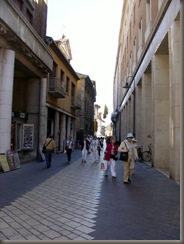
How very civilized! As you walk toward the main piazza, through the town from the train station, you are guided by a white brick path. It wasn’t really set up for tourists, but for bicycles. The tourists don’t seem to know it yet, and the townspeople trying to ride their bikes are forced to zigzag through the crowd. My impression was one of surprise at how lovely and tidy the city was, with well maintained buildings and sidewalks.

 DSC07607 DSC07608

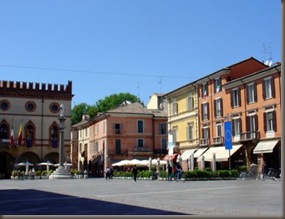
The Piazza del Popolo was charming and it was easy to find the tourist office where we were handed a helpful map with the main mosaic sites easily identifiable. Off we went to Basilica di San Vitale, the largest yet not the oldest of the mosaic sites, but not before we made a stop at Mercato Coperto, the traditional food market of Ravenna.

DSC07612

A right turn onto Via IV Novembre from the piazza brought us directly to the covered market where we did a bit of exploring. They have a small restaurant inside with inexpensive food to eat there or take out. There were plenty of produce vendors, fish mongers, and butchers, but I believe it was too late in the day to see any real activity.

DSC07617 DSC07621

DSC07618 DSC07619

After politely inquiring for permission to photograph, simply saying “Permesso?” and holding up my camera, I was given the go ahead by every single vendor. It’s surprising how far a little courtesy will get you. Some camera shy vendors asked not to be photographed which was very easy for me to comply with, as I was primarily interested in the food. That seems to confuse many people, especially waiters who often offer to take a photograph of me when they see my camera on the dining table.

DSC07623

DSC07620 DSC07622

DSC07625

On the way we passed Sorbetteria Degli Esarchi, which we later returned to for a quick gelato and another lesson in courtesy. The young woman was trying to help an English speaker who made no effort to speak any Italian at all, not even “grazie” . The customer didn’t attempt the often most successful trick of pointing to the item you wish to purchase, that many foreigners employ when they have little to no language skills.  It was easy to see the clerk was frustrated as the woman spoke louder and ignored the question about whether or not she wanted a cup or a cone.

DSC07704 DSC07700 DSC07697

It pleased me to be able to ask for 2 cups of gelati in Italian, and the clerk was quite effusive in her response, all in English I might add. One small polite word would have worked wonders for the other customer. I walked away with not only the gelati, but a postcard of the store, a small courtesy from the clerk. Their gelati were quite different than the usual suspects which they carried, but they seemed to have more original recipes. I had to try the creamy lemon gelato. I like lemon sorbetto, but the cream made a big difference in taste, also making the lemon sweeter and less acidic in the process.

DSC07699

In the photo above, from top to bottom you see chestnut; ricotta caramel fig, cassata, pistachio, berry, and creamy lemon gelati. I needed to try the fig, since it seemed the most unique. It was an excellent choice and I was looking for more of it throughout the trip, but there was none to be found. I can see that experimenting with a ricotta base will be on my list of ideas to try with my ice cream machine.  But barring that, it would be simple enough to add some chopped, dried figs to a simple syrup and cook it until the  sugar started to turn color, which is exactly what I believe was done by Esarchi for this flavor. It was a success.

DSC07701

Mercato Coperto, Piazza A. Costa, Ravenna

Sorbetteria Estarchi, Via IV Novembre, 11, Ravenna Italy

www.ravennamosaici.it

Saturday, July 09, 2011

Palombi or Oasi Di Birra

There's a long history between Palombi Enoteca and myself. When I originally stumbled upon it, we were staying for the first time in Testaccio, the former slaughterhouse area of Rome. A blue collar neighborhood needed a good enoteca and Palombi was it. Located just across the street from the Mercato Testaccio it had the ideal location for convenience to neighborhood shoppers. I discovered Dalle Valle Grappa Melone there and have been searching for it ever since, but Palombi stopped carrying it at least 15 years ago. The cantaloupe elixir was smooth, clear and had just the right amount of sweetness to make it appealing but not cloyingly sweet. I even made a trip to Rivo in the Dolomites to find some, but I digress.

DSC00300 DSC00302 

DSC00301 DSC00258

DSC00257 DSC00234

Palombi started carrying condiments some years back, along with pasta and other comestibles. Of course, they stocked wine and have become the place to go in Rome for imported beer; over 600 varieties. They evidently opened a cheese store too, which I still haven't found nor seen, but it was clear that they were serving food on my second trip there, as tables were set up in the middle of the wine shop in the evenings. I resisted, preferring traditional trattorie and especially Perilli 2 short blocks away.

 DSC00230

On our prior trip in 2009, we sat outside for a glass of wine and enjoyed Palombi in a different way, since it was not just a shop anymore. Still we did not make a reservation for dinner at that time. Since Palombi was gaining a great reputation for its vast beer collection, hence the name Oasi Di Birra, we decided to go back this trip and see if we could find the Danish beer, Ceres Red Erik that we had tried earlier in Malta. The color is surprisingly red and the taste is more like a Belgian Trappist beer.  Palombi had it. Red Erik is now my new favorite beer, that’s saying something, since I hated all beer before I tried the Belgians and realized that a sweet beer was just what I needed for my conversion.
DSC00231 DSC00269

DSC00270

The waiter asked if we wanted to have the buffet, but we turned it down. He then insisted that we take a look, so my dining companion went back to look. He returned with a big smile on his face and a plate piled high with salumi, cheese, olives, meatballs, pasta and various other antipasti. His second plate materialized about 20 minutes later.

DSC00250 DSC00254

DSC00241 DSC00247

DSC00246 DSC00249 

This was surprising, since we had made a reservation for dinner in the Palombi restaurant. The justification was because he had skipped lunch and it was only antipasti. That was good enough for me, but I had not skipped lunch, so I had to pass on the antipasti. However, that did not prevent me from walking inside to photograph as much of the food as possible.

 DSC00251 DSC00248

DSC00242

Never one to pass up a good deal, I made plans to return the next evening to make a dinner of the antipasti. Did I forget to mention the price? Five euro for as much antipasti as you could eat with the purchase of a 5 euro beer. I have no idea how they cannot lose money on that deal, since people were going back 2 and 3 times for more food. Ten euro for dinner and a drink has to be legendary in Rome, and the word is getting out, because people were lined up waiting for tables.

DSC00502 DSC00504 

DSC00503

The interior of Palombi was much larger than I had remembered, I suspect additional rooms were added as soon as they were available to rent or purchase. The space had doubled or tripled, since I first stepped through their door. For dinner we were placed in the furthest dining room, which was occupying the corner of the block, so at least 3 buildings worth of ground floor space must have been added.

DSC00275 DSC00281  

Salads in Italy were never very inventive, but times have changed and Palombi makes some wonderful combinations with generous portions for 7 euro. I tried the orange, artichoke, and black olive salad while my companion opted for the shrimp, grapefruit, blood orange and lemon salad. Neither of us talked during the salad course, since one should never talk with one's mouth full. We literally did not put our forks down; a complaint many Europeans express about Americans.

DSC00280 DSC00283

DSC00292

I decided to try another classic Roman pasta and ordered the Pappardelle with fave, pancetta and pecorino cheese. Home made pasta was not what I was expecting for 8 euro, but far be it from me to complain! The pasta was delicious and I think I will start mincing the pancetta when I make this at home. The minced pancetta seemed so much richer. It was nice to see that Romans don't peel fave either, since I have always considered it a waste of time.

DSC00501  DSC00506

DSC00507

The next afternoon I saw the young British couple I had offered my extra wine to at Alfredo & Ada during lunch on the previous day. They had just finished lunch in Testaccio as I was returning to the hotel, so I told them about Palombi. As chance would have it, we sat next to them for our antipasti dinner. We all agreed that this was a great value in Rome. In the above photo there are two polpette. The one on the right is made from fava beans and the one on the left is something I have only heard of before, but never seen on a menu. It’s basically made from egg and breadcrumbs, like stuffing or what we would call a dumpling. Served with gravy, it was very good and a nice vegetarian alternative to a meatball.