Thursday, August 18, 2011

Cafe Caravaggio in Valletta Malta

DSC08806

Spending five nights in one city affords one the luxury of possibly finding an exceptional restaurant. Cafe Caravaggio may not be that restaurant, but I assure you the salads were excellent. Sitting across the piazza from St. John's Co-Cathedral gives this restaurant a chance for stiff competition and Cafe Caravaggio aims to please. San Giovanni Caffe next door does not come close in terms of salad preparation.

DSC08796 DSC08797 DSC08801

When ordering the Insalate di Tonno I was prepared for a Nicoise type salad with all the ingredients piled high in the center. As you can see by the photo, it was divided into two sections, one of crisp greens and tomato, the other of tuna looking like tartar but fully cooked and mixed with green olives and capers. This was fresh and exciting after iceberg lettuce and tomatoes from other restaurants.

DSC08795 DSC08800

The Chicken Cesar ordered by my dining companion could compete favorably with any Irish Cesar Salad, none of which were the same nor similar in the slightest. No anchovies, no egg dressing, but a generous amount of prosciutto was added to the mix, just to make it Mediterranean we presumed. Regardless, it had shaved parmigiano and an interesting mix of vegetables and was so satisfying, my companion said he would have easily liked it as well even if it didn't come with chicken.

DSC08803 DSC08992

We asked to be seated in no man's land where the waiter forgot us more than a few times. The owner was very gracious and wanted to comp us a cup of coffee or dessert, but we were satisfied with what we had eaten. Make it a point to sit outside at a restaurant where most of the tables are not inside, or you may find yourselves with little if any service too. Still that was no deterrent, because we went back a second time on a very warm evening when a large salad would make a perfect dinner. We tried the “Cesar” salad without chicken and as suspected, the loss of chicken was no loss to the taste and success of the salad.

DSC08994 DSC08995 DSC09000


Even though the evening was warm, I didn’t want to miss my chance to try swordfish in Malta, so I ordered it and was very pleased to eat it. The dinner came with fries and a salad of no particular merit, but still easy enough to eat. The preparation of the swordfish itself was quite good as it had been cooked in a tomato sauce made from fresh, vine ripened and sweet tomatoes with savory green olives and capers. It was colorful, full of great eye appeal and had the plate decorated with a syrupy balsamic for good measure, with fresh parsley confetti.

9 St John Square, Valletta, Malta
(+356) 2123 6257

http://allmaltaonline.com/cafes/cafe-caravaggio/

Wednesday, August 10, 2011

Lost In Translation…Dog Park

DSC00519 DSC00488 DSC00487

As we can see, it is not exactly a dog’s world in Rome, at least, dog amenities as we know them do not seem very present, or are they? If you take a look at the item below that seems to pop up around Piazza Testaccio on a frequent basis, it seems quite possible that our K9 friends might have better amenities than it first appears. At least they do not need to depend upon the kindness of strangers to quench their thirst. Although, the resemblance to a fire hydrant in the U.S. makes me feel a bit queasy. Someone, please tell me that is a water fountain and not a pissoir.

DSC00494

Sunday, August 07, 2011

Il Forno The Oven, Il Fornaio The Baker


Very few tourists to Italy understand the historical importance the bakery had to the community surrounding it. It amuses me to hear complaints about Italian apartment rentals not having large ovens. Historically, most Italians had no ovens at all. Women would take their bread and meat to communal ovens of their town or village for baking and roasting, then return to pick them up, the way we walk into a restaurant for take out food. So this made the forno a major player in every Italian community. In Liguria focaccia was developed in order to test the communal oven to see if it was hot enough to bake bread. Whether it’s called a Panificio, Focaccieria or Il Forno, the bakers are integral to their communities. The bread culture in Italy is pervasive with regional festivals and many towns whose reputation rest on claims of making the best bread in the country.


Forno Antico Santa Chiara is in one such town, Altamura in Puglia. As we left Matera, one of the desk clerks from Hotel San Martino suggested that if we wanted the bread with the D.O.P. designation, we should try this very old bakery. She forgot to tell us about the focaccia that we discovered was the very best we have ever eaten.

Specific shape doesn’t seem to matter, what does matter is that this bread is said to last for 8 – 15 days. That would be a small miracle, because it would be impossible to keep it in the house that long. Our small loaf was shared with friends and we polished it off at one sitting. The crust was crisp and it had a firm crumb with a very nice flavor.


The texture of the bread looked similar to the loaf in the photo on the left, baked by a friend of the family we were visiting. The Pane di Altamura loaf was a bit darker, with a yellow cast, but the crumb was identical. Admittedly, for us the real star of the show was the focaccia that came in many variations and was delicious beyond our expectations. Besides the tomato, it came in onion, zucchini and the zucchini and eggplant combination that you see in the photo on the right.

More photos are better, right? I’m only sorry I didn’t take a photo if the onion focaccia before we inhaled it.


I did however manage to control myself long enough to snap this photo of it sitting atop the map on my lap, as we drove away from Altamura. Truly, I would not even consider going to Southern Italy on another trip without a stop in Altamura for more focaccia. It is mind boggling how simple ingredients like bread, onion, olive oil, oregano and salt, when combined can become a euphoric distraction. Our next itinerary is already planned; one of each wrapped to go (porta via) to place in the car trunk for safekeeping until we arrive at the next hotel, and another for the trip to that hotel, or to eat at the small table outside the forno. The to and from destinations are not as important as returning to Altamura.


The bakery also sells biscotti as you can see on the far left of the photo on the left or in the photo on the right. Antico Forno di Santa Chiara has been in business for generations, since before Columbus discovered America! With products like these, it is no wonder. I’d like to share one more photo with you.

As a former potter, the two small breads above the door did not go unnoticed by me. I had seen many tributes paid to and images made of “kiln gods” as “insurance” for a successful “firing”. I suspect this was the baker’s way of asking for a blessing on his forno and the successful baking of his daily bread. That’s my story and I’m sticking to it.

Via Ambrogio del Giudice 2, Altamura, Provincia di Bari, Puglia

Il Fornaio is a very popular sign seen on bakeries all over Italy, but does not necessarily indicate the name of the bakery. Il Fornaio in this photo is located just off Campo di Fiori in Rome’s Centro Storico neighborhood and that is indeed the name. A very popular bakery with tourists who just stumble across it on their visit to the Campo, Il Fornaio also attracts locals who know that it is a great spot for a quick lunch.

As you might be able to tell by the photos I took through the display cases above, zucchini focaccia as well as tomato is available, but more importantly, this bakery has a very good reputation for pizza bianca, the white focaccia so typical of Rome. They also display the largest mortadella I have ever seen. It must be 5 feet long and the width is bigger than a man’s head, and I have photographs to prove it. As an ongoing joke, two generations of my family have posed with what we refer to as “Big Mort”. Besides the foccacia, Il Fornaio also sells panini and suppli (rice croquettes filled with mozzarella) for it’s customers needing a quick purchase, and I’m told the cannoli and other pastries are good too. More often than not, locals will go in and order a slice of mortadella layered onto a piece of pizza bianca.

Via dei Baullari, 5
00186 Rome
Tel: 06 68803947‎

In Florence, Il Fornaio Galli has several locations, but we visited the one on Via Sant Augostino in the Oltrarno neighborhood of Santo Spirito. Once again focaccia was quite prominently featured and it got us in the door. It made for a great snack, but but don’t forget to take a look at the pastries.

Don’t those tuna pockets on the top shelf look like a light lunch in the making or perhaps the spinach and ricotta version next to them? Looks like Il Fornaio is giving patrons some nice vegetarian options with the zucchini or porcini pizze in the center of the case. the sausage focaccia or pizza also look like a nice way to keep mid afternoon hunger at bay, but the pizza bianca with prosciutto cotto is probably what most locals eat, if they are anything like their Roman counterparts.

All that bread and those rolls look like a good addition to any pantry if you are renting an apartment. It would be easy enough to make your own panini if you also visited a salumeria or small grocery store. Cookies and pastries looked very classic here and would had been hard to resist, if it were not for the fact that we already had reservations for a late lunch with friends. That didn’t however, deter someone I know from ordering a slice of potato and rosemary focaccia.


Firenze: Via S.Agostino 8/r

Piazza delle Cure 15

Via Pacinotti 43/r

Via dei Neri 18

http://www.giovannigalli.net/galli-panificio.asp

Friday, August 05, 2011

By All Means, Go


Find yourself a good guidebook and please see as many things as possible, but don’t limit yourself to the tourist trail. Some of the most fascinating, memorable moments you will have on your trip will be those times you go into backstreets never ventured into by tour groups. Take along a map so you can feel free to get lost, but will have a means to be found. The Colosseum ( Coliseum) is one place you couldn’t miss if you tried because it dominates the landscape, but don’t linger there as it is a popular place for pick pockets as well as tourists. Piazza Navona is the place to people watch or sit for a drink, but its side streets are just as, if not more, interesting.


The Roman Forum can keep you busy for hours, but don’t miss the Monti neighborhood just to the east, an upscale quarter filled with lovely shops and restaurants, with some streets so narrow you can hardly get through them in a taxi. A walk down Via Madonna Del Monte or Via Serpenti will provide you with lots of things to see and do.

The Pantheon may satisfy your interest in architecture, but the restaurants in the neighborhood up the small side streets will do much more for your appetite. You can no longer tell a tourist restaurant by the number of languages on the menu, so follow your nose and walk away from monuments and museums to find restaurants filled with locals. If the windows are frosted, it’s probably filled with locals who frown on being gawked at by tourists while they are dining.

We have all seen countless photos of the Trevi Fountain, but definitely go to see it so you have a sense of scale about it. Life is not in Cinemascope and neither is the fountain. The first time I saw it in person I found it difficult to believe I was in the same piazza where Three Coins in the Fountain had been filmed. I have never seen it as it was portrayed in that film. And each time I return, it seems smaller and the crowds larger.

Thursday, August 04, 2011

Il Colosseo

I think it would be impossible for someone to think of Rome and not have it accompany a visualization of the Colosseum. Even though there still exist dozens of arenas like it, none are as big nor do they dominate the landscape the way this one does. It is a natural tourist magnet, but that’s the rub. It also attracts pick pockets, since tourists make easy targets and locals avoid the place. We make easy targets because most of us are not there long enough to press charges or go to trial. My husband was once surrounded by 4 or 5 Gypsy children who encircled him, swarming like bees to honey, and they got away with a bag of postcards.

If you go, remember to wear a money belt and don’t be careless with a purse or camera. Crawl around all you like, see the colonies of cats and have fun, just don’t loiter around or carry anything valuable in your pockets. Study your maps on the way there and don’t get distracted, be vigilant. My husband paid a very small price for his lesson in precaution, but others may not. Bus #64 to the Vatican is also notorious for pick pockets and has been for decades. On our visit to Malta, we noticed that locals all wore their backpacks in front. There’s a good lesson in that.

If you see any “Romans” wandering around, they are there to pose for photographs in order to earn a gratuity. Please respect their meager yet honest way of trying to earn some money.

Wednesday, August 03, 2011

Piazza Navona


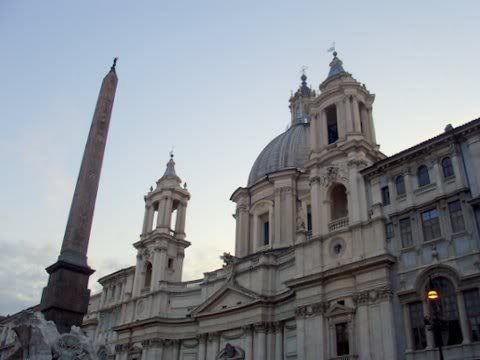
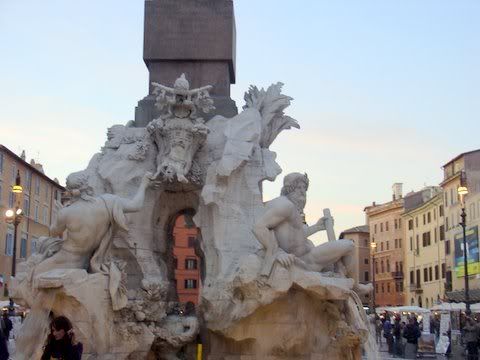
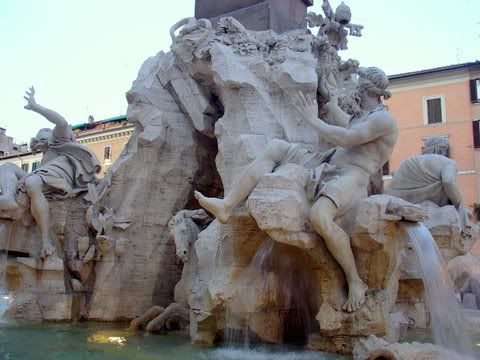
The Piazza Navona is on many lists of must see sights in Rome and for good reason. It not only serves as a great framework for Bernini's Fountain of the Four Rivers, but it provides a broad open space for many activities. You will undoubtedly run into street artists and performers, but if you're either lucky or you plan well, you can find a market or festival in progress.


If you look at the background in this photo of Fontana Dei Quattro Diumi you'll see market stalls set up, perhaps for some of the painters. The Piazza is the home of a very popular Christmas market that I once attended. It was crowded with vendors selling ornaments and Nativity creches filled with a multitude of characters, including the expected Virgin Mary, St. Joseph, and Baby Jesus. In Italy you can always find the fruit peddler, cheese seller and oddballs you never could imagine on your own. We also found a variety of candy sellers specializing in black crystallized sugar that looked like lumps of coal, undoubtedly for "bad" children. I wondered what the briskly selling twigs were; did "good" children get shortchanged by having to be content with chewing on wood?


The Fountain of the Four Rivers represents the four corners of the earth by depicting the Nile, Ganges, Danube, and Rio De La Plata. If you look at the figure on the far left, with its defensive pose, that is said to be Bernini's reaction to the church across from the fountain, designed by his rival for papal commissions, Francesco Borromini. Fact or fiction, does it matter when it's a good story?

The Pantheon


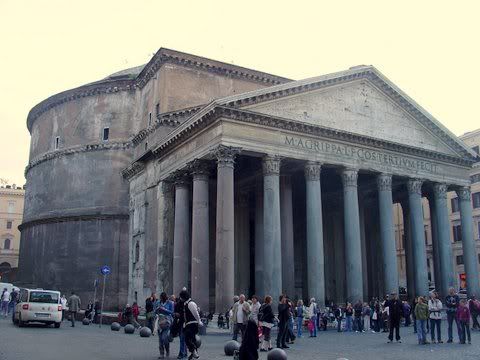
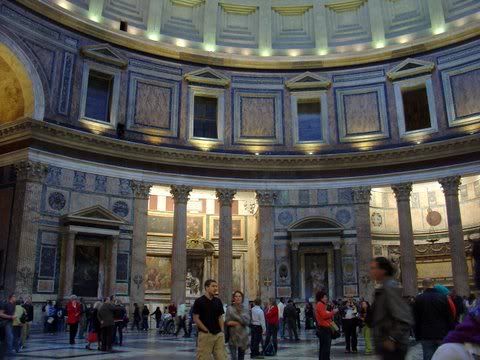
You can certainly find out a lot about the Pantheon by Googling or reading history books and guidebooks, so I'm not going to gather that information and repeat it here. I'm hoping that a picture will be worth a thousand words or at least a few hundred. But I would like to pass on something that I heard while watching television. The reason the domed roof was able to cover that span and not come crashing down was because of very clever engineering. Each level of concrete in the dome was poured thinner than the previous level and in turn the concrete was adjusted to have more tuff (or tufa as it is called by Italians, a light weight volcanic rock) added to the mix, thus making it lighter. Even the textural element of the squares were included not only as a design element, but to allow for less material to be used.


The scale of the building is still impressive even though it has been encroached upon by other buildings over the centuries.It has an ancient almost mysterious air about it, perhaps prompted by its lack of windows. As you may already know, the interior is an active church. The series of chapels must be used individually, since the seating is divided amongst them. I do hope they clear out the tourists during mass as the crowds would be a serious distraction. I've had to fight my way into many churches to attend services, so I must still appear to be a tourist despite my efforts to blend in.